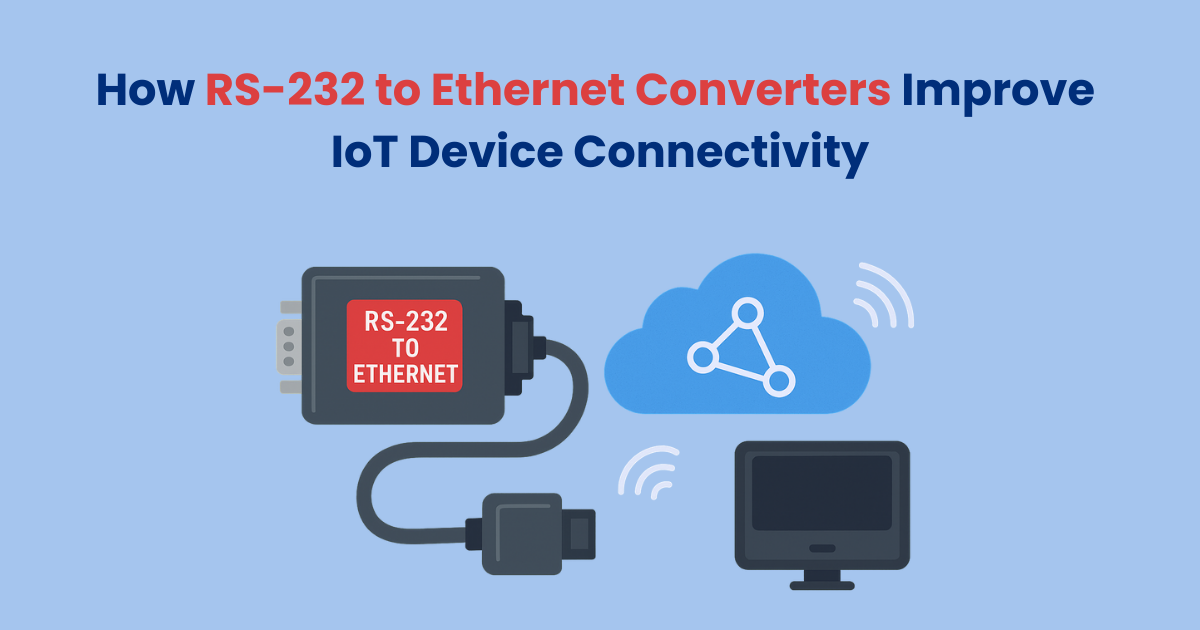
The rise of the Internet of Things (IoT) has brought a new wave of connectivity and automation across industries. But legacy devices that rely on RS-232 serial communication often cannot directly interface with modern IP-based networks. RS-232 to Ethernet converters bridge this gap, enabling these older devices to become part of the IoT ecosystem. Below, we explore in detail how these converters improve IoT device connectivity.
RS-232 and IoT Connectivity
RS-232 is one of the earliest serial communication standards, widely used since the 1960s. Devices like sensors, industrial machinery, barcode scanners, and medical instruments still rely on RS-232 for data transfer due to its simplicity, reliability, and low cost.
However, modern IoT systems are built on TCP/IP networks, which allow devices to communicate over local area networks (LAN), wide area networks (WAN), or even cloud-based platforms. RS-232 cannot natively interface with these networks, which creates a connectivity gap.
By using RS-232 to Ethernet converters, organizations can connect legacy devices to IP networks. This integration ensures that older equipment can participate in real-time monitoring, remote management, and data analytics—key benefits of IoT adoption.
Challenges in Connecting Legacy Serial Devices to IoT Networks
Integrating RS-232 devices into IoT networks is not straightforward due to several challenges:
- Distance Limitations: RS-232 signals degrade over distances greater than 15 meters. In large factories, warehouses, or remote locations, this makes it difficult to connect devices to centralized IoT hubs without repeaters or converters.
- Incompatibility with IP Protocols: IoT networks rely on TCP/IP communication, whereas RS-232 transmits serial data as voltage signals. Without conversion, these devices cannot send or receive data across standard Ethernet networks or the internet.
- Scalability Issues: Adding multiple RS-232 devices to a modern IoT network can become complex. Each device may require unique cabling and configuration. Without converters, network expansion is inefficient and costly.
- Data Reliability Concerns: RS-232 is prone to interference, noise, and signal degradation over long distances, leading to incomplete or lost data. IoT applications require reliable, error-checked data transmission for accurate analytics and automation.
RS-232 to Ethernet converters solve these challenges by transforming serial signals into robust IP-based packets capable of traveling across modern networks reliably.
What is an RS-232 to Ethernet Converter?
An RS-232 to Ethernet converter is a hardware device that acts as a bridge between serial devices and IP networks. It converts RS-232 signals into Ethernet-compatible signals and vice versa.
Key Components of a Converter:
- Serial Interface (RS-232 port): Connects directly to the legacy serial device.
- Ethernet Port: Connects to LAN, WAN, or IoT platforms.
- Embedded Protocol Stack: Handles TCP/IP communication to ensure data packets are correctly formatted and transmitted.
- Configuration Interface: Allows network settings, baud rate, and protocol mapping to be adjusted via software or web interface.
These converters essentially give “network intelligence” to devices that were previously limited to point-to-point serial communication.
Key Benefits of Using RS-232 to Ethernet Converters in IoT
a) Enhanced Device Connectivity
RS-232 to Ethernet converters make it possible for devices that previously communicated over serial cables to now integrate with IP networks. This enables data from older devices to flow into IoT platforms, dashboards, and analytics systems. For example, a legacy temperature sensor in a factory can transmit real-time readings to a cloud-based monitoring system.
b) Extended Communication Range
Ethernet allows data transmission over distances of up to 100 meters per segment, extendable through switches or fiber-optic links. This overcomes RS-232’s distance limitations, enabling remote monitoring of devices located far from control centers. This is particularly useful in industrial plants, warehouses, or geographically distributed systems.
c) Improved Scalability
By converting RS-232 devices to IP endpoints, additional devices can easily be added to an existing network without complex rewiring. For example, a manufacturer can scale up an IoT-enabled production line by adding more serial devices via converters, all accessible from a central monitoring dashboard.
d) Reliable Data Transmission
Converters use TCP/IP protocols that include error detection and correction mechanisms, ensuring that data from RS-232 devices arrives intact and on time. This reliability is crucial for applications like medical monitoring, industrial automation, or energy management, where data loss can lead to operational risks.
e) Remote Monitoring and Control
With Ethernet connectivity, devices can be monitored and controlled remotely via web dashboards or IoT platforms. A warehouse manager, for instance, can check barcode scanners, temperature sensors, and conveyor systems from a single interface, reducing downtime and improving operational efficiency.
f) Cost-Effective Solution
Replacing legacy RS-232 devices with modern IoT-compatible equipment can be expensive and disruptive. RS-232 to Ethernet converters offer a cost-efficient alternative, allowing existing hardware to connect to modern networks and benefit from IoT integration without large capital expenditure.
Real-World Applications in Industrial and Commercial IoT
- Manufacturing Automation: Connect CNC machines, PLCs, and sensors to a central IoT monitoring system to track performance, detect anomalies, and enable predictive maintenance.
- Energy Management: Integrate legacy power meters and energy sensors into IoT platforms to monitor consumption patterns, optimize efficiency, and reduce costs.
- Healthcare: Link medical devices like infusion pumps and diagnostic equipment to hospital networks for real-time monitoring and data logging, improving patient care.
- Retail and Warehousing: Enable barcode scanners, RFID readers, and inventory management devices to communicate with cloud-based systems for accurate stock tracking.
- Transportation and Logistics: Connect GPS trackers, fleet sensors, and monitoring devices to IoT networks for real-time vehicle tracking, route optimization, and predictive maintenance.
Best Practices for Implementing RS-232 to Ethernet Converters
- Device Selection: Ensure the converter supports the device’s baud rate, protocol, and number of serial ports required.
- Network Configuration: Assign static IPs or use DHCP to avoid conflicts and ensure reliable network addressing.
- Security Measures: Implement encryption, firewalls, or VPNs to secure sensitive IoT data transmitted over Ethernet.
- Regular Monitoring: Use network management tools to monitor converter performance and connectivity health.
- Firmware Updates: Keep converters updated to address bugs, improve compatibility, and support new protocols.
Conclusion
RS-232 to Ethernet converters are a practical and cost-effective solution for integrating legacy serial devices into modern IoT networks. They enhance connectivity, extend communication range, improve scalability, and ensure reliable data transmission. By enabling remote monitoring and control, these converters help industries maximize the value of their existing hardware while embracing the benefits of IoT technology.
FAQs
Q1: Can RS-232 devices connect to cloud IoT platforms using converters?
Yes, converters translate serial data into IP packets that can travel over the internet to cloud-based IoT platforms.
Q2: What distance can RS-232 to Ethernet converters support?
Ethernet supports up to 100 meters per segment, extendable with switches, hubs, or fiber links.
Q3: Can a single converter handle multiple serial devices?
Some models support multiple serial ports or virtual COM port mapping, allowing several devices to connect simultaneously.
Q4: Do converters require special software for communication?
Configuration may require vendor tools, but after setup, devices communicate using standard TCP/IP protocols without additional software.
Q5: How do converters improve IoT data reliability?
By using TCP/IP protocols, converters provide error-checking, retransmission, and stable packet delivery, ensuring accurate and reliable data flow.