Industrial automation has become a cornerstone of modern manufacturing and process industries. Companies across power generation, oil & gas, water treatment, chemicals, and heavy engineering are investing heavily in automation to improve productivity, safety, and operational consistency. While automation is often associated with software, PLCs, and control systems, its real-world efficiency depends strongly on mechanical components—especially industrial valves.
In automated plants, valves are not just flow control devices. They act as execution points that translate digital control signals into physical action. When selected, designed, and integrated correctly, industrial valves significantly improve automation efficiency and overall plant performance.
Role of Industrial Valves in Automated Systems
In an automated process, every command issued by a control system must be executed precisely and reliably. Industrial valves perform this function by controlling the movement of liquids, gases, steam, or slurries within pipelines. They enable automation systems to regulate flow, isolate sections, control pressure, and ensure safety during both normal and abnormal operating conditions.
Without properly engineered industrial valves, automation systems lose accuracy, responsiveness, and reliability. This makes valve performance a critical factor in achieving efficient automation.
Precision Control and Process Stability
One of the primary ways industrial valves improve automation efficiency is through precise flow control. Automated processes require repeatable and accurate valve positioning to maintain stable operating conditions. Poor valve control leads to fluctuations in flow or pressure, which directly affects product quality and energy efficiency.
Automation-ready industrial valves are designed to provide consistent opening and closing characteristics. Their ability to respond accurately to control signals ensures that process parameters remain within desired limits. This precision reduces process variation, minimizes waste, and improves overall system stability.
Faster Response and Reduced Cycle Time
Manual valve operation introduces delays, inconsistencies, and dependency on human intervention. In contrast, automated industrial valves respond instantly to signals from PLC or DCS systems. This rapid response plays a key role in improving automation efficiency.
Fast-acting valves reduce cycle times in batch processes and enable real-time adjustments in continuous operations. In industries such as power generation or chemical processing, even small improvements in response time can lead to significant gains in productivity and energy savings.
Reduced Downtime and Improved Uptime
Unplanned downtime is one of the biggest challenges in industrial operations. Valve failure—such as leakage, seizure, or actuator malfunction—is a common cause of automation breakdowns. High-quality industrial valves are engineered to withstand demanding conditions such as high pressure, high temperature, corrosive media, and frequent cycling.
When industrial valves are correctly matched to the application, wear and tear is minimized. This reduces maintenance frequency and extends service life. As a result, automation systems operate with higher uptime, directly improving efficiency and production reliability.
Enhanced Safety and Risk Control
Automation efficiency is not only about speed and productivity; safety is equally important. In automated plants, industrial valves often serve as safety devices. They are responsible for emergency shutdowns, pressure relief, and isolation during abnormal operating conditions.
Fail-safe industrial valves automatically move to a predefined safe position in the event of power or air failure. This prevents equipment damage, environmental hazards, and risks to personnel. By ensuring reliable safety performance, industrial valves help automation systems operate confidently under critical conditions.
Energy Efficiency and Cost Optimization
Energy consumption is a major operational cost in automated plants. Inefficient valve operation can cause pressure drops, flow losses, and excessive pumping or compression requirements. Properly designed industrial valves reduce these losses by offering smooth flow paths and tight shut-off characteristics.
Automation-ready industrial valves support optimized process control, allowing systems to operate at ideal setpoints rather than compensating for mechanical inefficiencies. This leads to lower energy consumption, reduced operating costs, and improved overall automation efficiency.
Compatibility with Automation Technologies
Modern automation systems rely on feedback and diagnostics to function efficiently. Industrial valves used in automation are often equipped with position indicators, limit switches, and feedback devices. These features allow control systems to monitor valve status in real time.
By providing accurate feedback, industrial valves enable predictive maintenance strategies. Automation systems can detect early signs of wear or malfunction and schedule maintenance before a failure occurs. This proactive approach further improves efficiency by avoiding unexpected shutdowns.
Importance of Correct Valve Selection
Automation efficiency depends heavily on selecting the right valve type for each application. Not all industrial valves are suitable for automation. Factors such as process pressure, temperature, media type, operating frequency, and control requirements must be carefully evaluated.
For example:
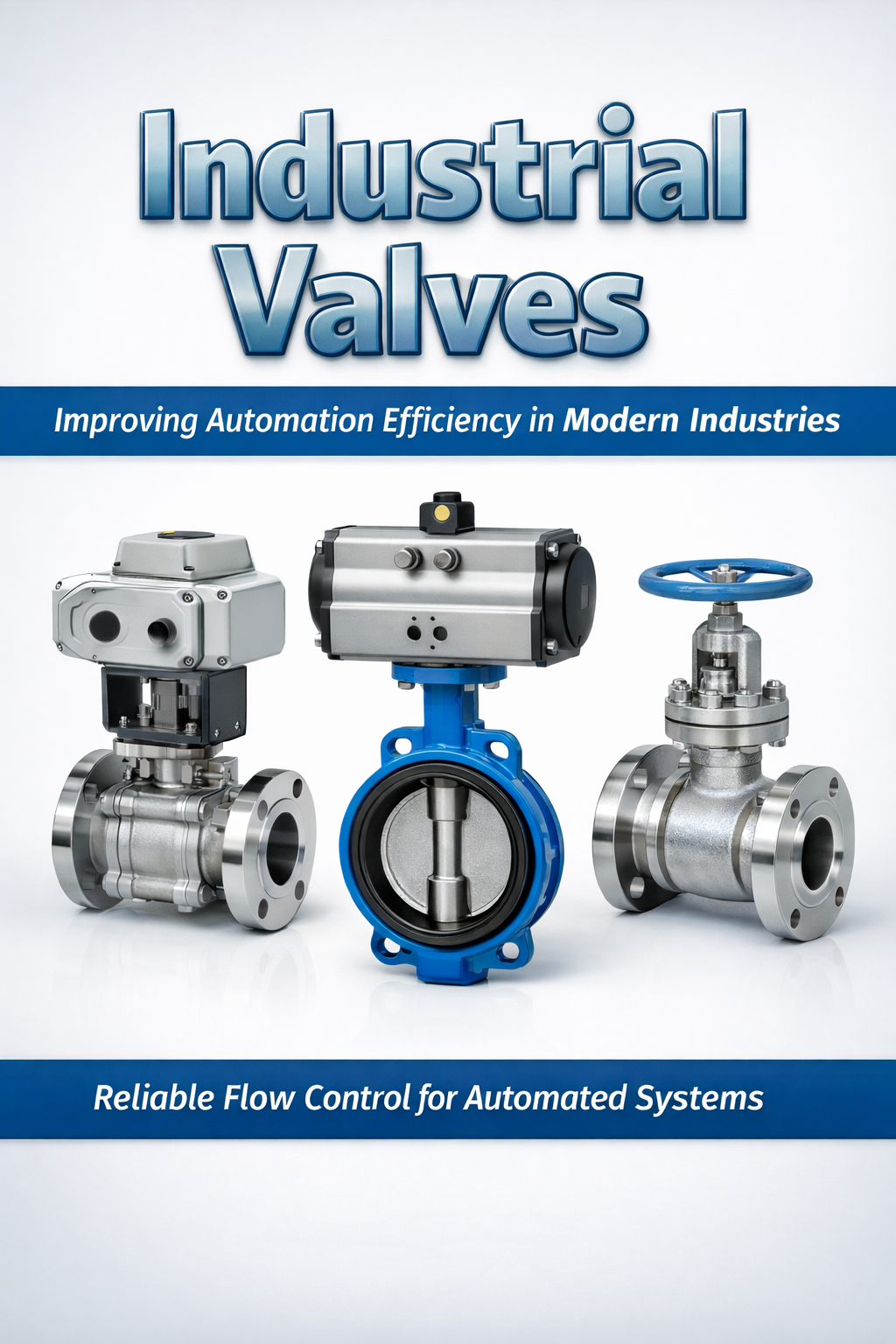
- Ball valves are ideal for fast on-off automation.
- Butterfly valves are suitable for large-diameter pipelines.
- Globe valves are preferred for precise flow regulation.
- Knife gate valves are used for slurry or solid-laden media.
Incorrect selection of industrial valves leads to slow response, actuator overload, leakage, and frequent maintenance—negatively impacting automation performance.
Integration with Electric and Pneumatic Actuation
Automation systems use electric or pneumatic actuators to operate industrial valves. Each actuation method has its advantages, but both require valves that are designed for automated operation. Proper mounting standards, torque requirements, and sealing arrangements ensure reliable valve-actuator integration.
When industrial valves are engineered with automation compatibility in mind, actuators operate efficiently without excessive power consumption or mechanical stress. This seamless integration contributes directly to smoother and more efficient automation processes.
Long-Term Reliability and Lifecycle Performance
Automation is a long-term investment. The efficiency gains achieved today must be sustained over years of operation. Industrial valves designed for automation are built with durability, material compatibility, and lifecycle performance in mind.
Reliable industrial valves maintain consistent performance over thousands of cycles. This long-term reliability reduces replacement costs and supports stable automation performance throughout the plant’s operational life.
Conclusion
Automation efficiency is not determined by control software alone. It depends equally on the mechanical components that execute automation commands. Industrial valves play a central role in enabling precise control, fast response, safety, energy efficiency, and long-term reliability in automated systems.
By selecting high-quality, automation-ready industrial valves and integrating them correctly into automation architectures, industries can significantly improve operational efficiency, reduce downtime, and enhance safety. As automation continues to advance, the importance of well-engineered industrial valves in achieving efficient and reliable automation will only grow.