How Many Candlestick Patterns Are There: A Simple Guide for Beginners
Trading can seem like a mysterious art, especially when you first glance at a candlestick chart. All those little rectangles and lines dancing up and down — what do they really mean? Don’t worry, you’re not alone! Learning candlestick patterns is like learning the language of the market. Once you understand it, you’ll start seeing stories behind price movements instead of just random numbers.
Before diving into names and types, let’s first understand how many candlestick patterns actually exist — and more importantly, which ones truly matter.
Wondering how many candlestick patterns are there? Discover trading candlestick patterns and how online stock market courses can help you master them.
What Is a Candlestick Pattern?
Imagine a candlestick chart as a storybook of trader emotions. Each candle shows a battle between buyers and sellers within a specific time frame — that could be one minute, one hour, or one day. The candle’s body captures where the price opened and closed, while the wicks (also called shadows) show the highest and lowest price during that period.
So, a candlestick pattern is simply a specific formation created by one or more candles that indicates what might happen next. It gives hints — kind of like facial expressions for the stock market!
Why Traders Love Candlestick Charts
Traders adore candlestick charts because they make it easier to spot trends. Unlike plain line charts, candlesticks tell you how the price moved within each session. You can see whether traders were greedy, fearful, or undecided.
Here are a few reasons candlestick charts stand out:
- They’re visual: Easy to read and interpret.
- They show psychology: Each pattern represents market sentiment.
- They help timing: Perfect for identifying entry and exit points.
- They’re universal: Used across forex, stocks, and crypto.
Once you start recognizing trading candlestick patterns, they can become your best friends for decision-making.
How Many Candlestick Patterns Are There?
Here comes the big question — how many candlestick patterns are there?
There are over 100 known candlestick patterns, but don’t panic! You don’t need to memorize them all. Most traders focus on around 30–40 key patterns, which are proven to give reliable signals.
To simplify, experts divide them into:
- Single candlestick patterns
- Double candlestick patterns
- Triple candlestick patterns
Each group tells a unique story and serves a specific purpose — whether predicting reversals or confirming ongoing trends.
Basic Anatomy of a Candlestick
Before identifying patterns, you should first decode a single candlestick. It has four main parts:
- Open: The price at which the candle begins trading.
- Close: The final price when the trading period ends.
- High: The top of the wick, showing the highest price reached.
- Low: The bottom of the wick, showing the lowest price reached.
If the closing price is higher than the opening, the candle turns green (or white) — a bullish candle. If it’s lower, it turns red (or black) — a bearish candle.
Major Types of Candlestick Patterns
Broadly, candlestick patterns fall into two categories:
- Reversal patterns – signal a possible change in trend.
- Continuation patterns – suggest the current trend might continue.
Each of these can be bullish or bearish, depending on the market psychology.
Bullish Reversal Patterns
These indicate that the downward trend might be ending and an upward movement could start. Examples include:
- Hammer: Looks like a short body with a long lower wick. It shows buyers pushing prices up after sellers dominated early.
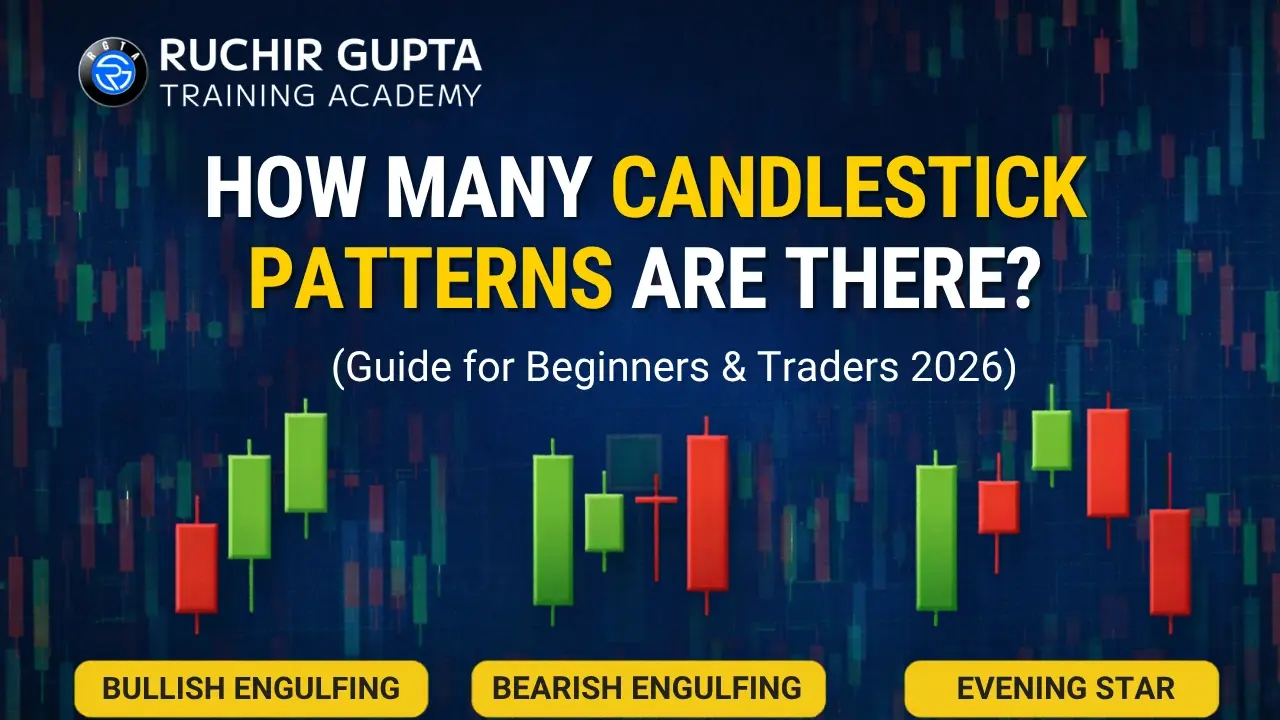
- Bullish Engulfing: When a big green candle completely swallows the previous red one, signaling strong buyer momentum.
- Morning Star: A three-candle pattern showing a market shift from bearish to bullish sentiment.
Think of bullish patterns as rays of sunrise after a dark night on the chart!
Bearish Reversal Patterns
These show that a price rise might be ending and sellers could take charge. Common examples:
- Shooting Star: A small body with a long upper shadow — hints that buyers tried to push higher but failed.
- Bearish Engulfing: The opposite of bullish engulfing; a large red candle covering the previous green one.
- Evening Star: A mirror image of the Morning Star, marking the beginning of a downtrend
Continuation Patterns
Sometimes, the market takes short breaks during trends. Continuation patterns tell you the trend is likely to resume.
Popular examples:
- Rising Three Methods: Shows a pause during a bullish trend, followed by continuation.
- Falling Three Methods: Indicates temporary consolidation during a bearish trend.
- Doji: A candle where open and close are almost the same, representing indecision but often preceding major moves.
Single Candlestick Patterns
These are formed by just one candle but can still be powerful:
- Hammer
- Hanging Man
- Inverted Hammer
- Shooting Star
- Doji
Each single pattern speaks volumes — like a snapshot of market mood.
Double Candlestick Patterns
Two candles combine to form signals for market reversals or continuations:
- Bullish Engulfing
- Bearish Engulfing
- Piercing Pattern
- Dark Cloud Cover
- Tweezer Tops and Bottoms
They show a fight between buyers and sellers that usually ends with one side winning decisively.
Triple Candlestick Patterns
These are combinations of three candles giving high-confidence signals:
- Morning Star
- Evening Star
- Three White Soldiers
- Three Black Crows
Think of them as three-act plays where each candle contributes to the story until the final move becomes clear.
Top 10 Most Popular Candlestick Patterns
If you’re just starting out, here are the ten patterns every trader should know:
- Doji
- Hammer
- Shooting Star
- Bullish Engulfing
- Bearish Engulfing
- Morning Star
- Evening Star
- Three White Soldiers
- Three Black Crows
- Hanging Man
You’ll see these everywhere — they’re the “celebrity patterns” of candlestick trading!
How to Recognize Them on a Chart
Start with practice. Open any stock chart and switch to candlestick view. Notice the length of wicks, bodies, and colors. With time, you’ll spot these patterns instinctively — just like recognizing familiar faces in a crowd.
A helpful analogy: learning candlestick patterns is like learning to read someone’s emotions. The more you observe, the better you understand whether the market is confident, nervous, or uncertain.
Common Mistakes Beginners Make
Even experienced traders sometimes misread patterns. Watch out for these common pitfalls:
- Overanalyzing every candle: Not every formation means a trend reversal.
- Ignoring volume: Patterns are stronger when supported by high trading volume.
- Forcing interpretations: Wait for confirmations before acting.
- Skipping practice: Understanding comes only with time and observation.
Remember — practice doesn’t just make perfect, it makes profitable.
Why You Should Learn Through Online Stock Market Courses
Learning on your own can feel overwhelming. Thankfully, online stock market courses make it easy to master candlestick charts with structured lessons, real examples, and expert insights.
Here’s why they’re worth it:
- Step-by-step explanations of trading candlestick patterns.
- Visual chart analyses for better understanding.
- Practice sessions to apply what you learn.
- Certificate programs that boost your credibility as a trader.
It’s like having a seasoned mentor guiding you through each candle’s hidden language. Platforms such as Zerodha Varsity, Coursera, and Udemy offer excellent beginner-friendly courses.
Conclusion
So, how many candlestick patterns are there? Technically, more than a hundred — but you only need to master a few dozen to trade effectively. Candlestick patterns are more than colorful boxes; they represent the heartbeat of the stock market. Once you start “listening” to them, you’ll read the market’s emotional pulse like a pro.
Whether you choose to learn independently or through online stock market courses, remember that trading success depends not just on identifying patterns but understanding the psychology behind them. Every candle tells a story — are you ready to read it?
FAQs
1. How many candlestick patterns are there?
There are over 100 candlestick patterns, but most traders use around 30–40 key ones to make informed decisions.
2. Which candlestick pattern is the most reliable?
The Bullish Engulfing and Morning Star patterns are often considered highly reliable for reversal signals.
3. Can I trade using only candlestick patterns?
While possible, it’s better to combine them with other tools like volume and trend indicators for stronger confirmation.
4. Are candlestick patterns useful for beginners?
Absolutely! They’re visual, intuitive, and help new traders easily understand market direction.
5. How can online stock market courses help me learn candlesticks?
These courses offer structured lessons, practical examples, and expert guidance — simplifying complex ideas into understandable chunks.