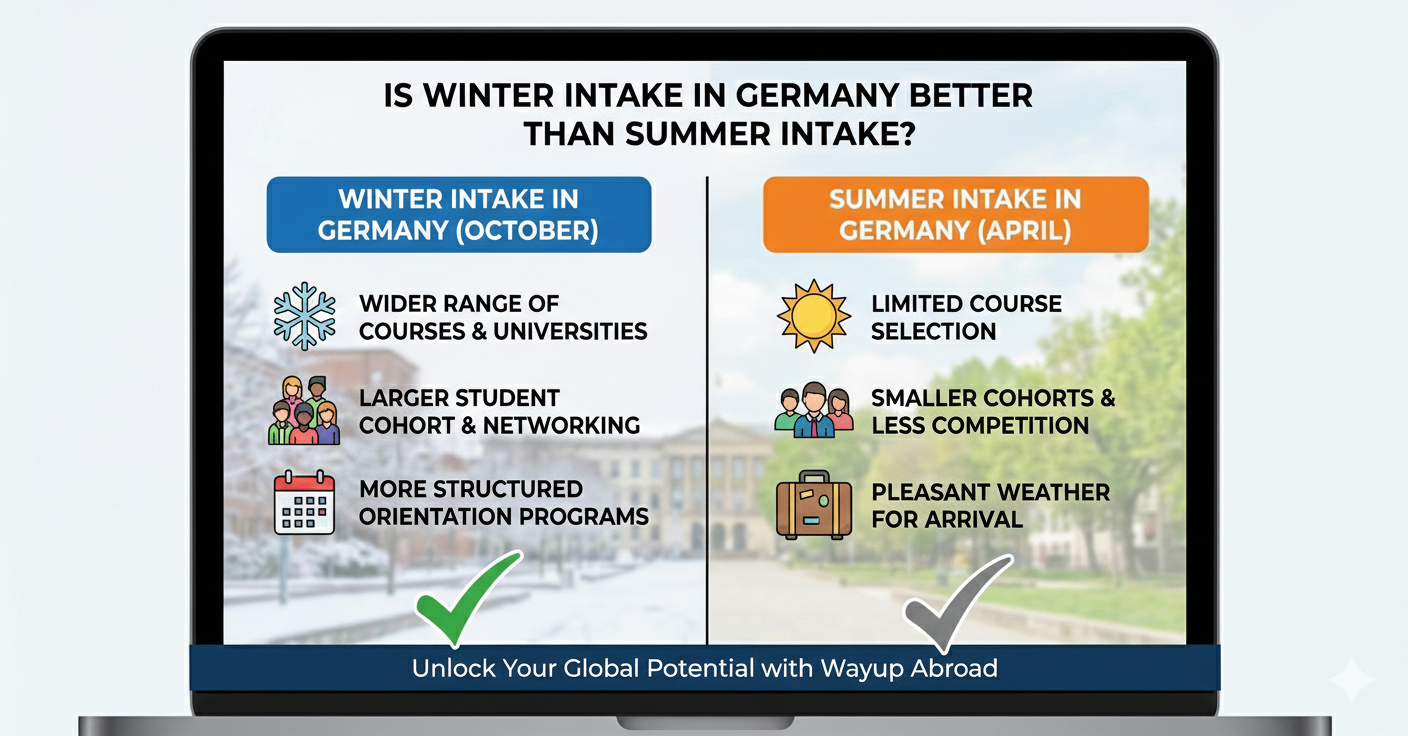
Hey, if you’re an Indian student right now trying to decide between the winter intake (October start) and summer intake (April start) for your bachelor’s or master’s in Germany in 2026/27, you’re asking one of the most common questions we get. Both intakes are open to international students, both lead to the same German degree, and both give you the 18-month job search visa after graduation. But they feel very different in practice, and for most Indian students, one usually ends up being the clearer, more practical choice.
Here’s a straightforward comparison of the winter and summer intakes in Germany based on how they actually play out for Indian applicants so you can see which one better fits your situation.
Winter Intake in Germany – The Main and Most Popular Entry
The winter intake (starting October 2026) is the primary academic start in Germany. Almost every university, public and private, top-ranked and mid-tier opens its full range of programs here. This is when you get the maximum number of courses, especially in high-demand fields like computer science, engineering, data science, mechanical engineering, business, AI, and natural sciences.
Winter Intake in Germany deadline for most master’s programs is mid-July 2026 (15 July) for non-restricted courses, but restricted programs can close as early as mid-May or early June 2026. Applications usually open in April/May 2026. This gives you a decent window to prepare documents, get your APS certificate, and submit without rushing too much.
Summer Intake in Germany – Smaller and More Limited
The summer intake (starting April 2026) is the secondary entry. Fewer universities offer it, and even at those that do, the course selection is much smaller often only a handful of master’s programs, mostly in less competitive fields or continuation semesters for students already in Germany. High-demand programs (CS, engineering, medicine, business at top unis) are rarely available in summer.
Summer Intake in Germany offer courses to specific institutions which include the University of Stuttgart and RWTH Aachen and University of Mannheim and University of Potsdam and several applied sciences universities which are known as Fachhochschulen. The submission deadlines occur before mid-January 2026 which requires you to complete your work at an accelerated pace.
Pro: Winter Intake Has Far More Course Choices
Winter intake wins hands-down on variety. If your target program say MSc in Computer Science at TU Munich, RWTH Aachen, or Karlsruhe Institute of Technology is only offered in winter (which most are), you have no choice. Summer intake simply doesn’t have the same breadth, especially for English-taught programs or competitive fields.
Pro: Better Scholarships and Funding in Winter
Most scholarships, DAAD funding, Deutschlandstipendium, university merit awards, and other funding are tied to the winter intake because it’s the main start. Summer has fewer scholarships, and many aren’t even available.
Pro: Winter brings full orientation weeks, welcome events, student societies, and networking from day one
For Indian students, this means bigger Indian student communities, easier to make friends, join cultural groups, and build a support network immediately. The summer season becomes peaceful because domestic students have established their wintertime activities while international students have decreased in number.
Pro: Head Start on Part-Time Jobs and Internships
Winter starters get the earliest access to part-time work (up to 20 hours/week) and internships, companies hire more in fall, campus jobs are open, and you have the full academic year to build experience.
Con: Winter Intake Is More Competitive
Winter has the highest number of applicants from India, China, Iran, and other countries. The popular programs reach full capacity at a faster rate, which requires you to submit your application before the May/June 2026 deadline for restricted courses.
Con: The summer intake provides students extended preparation time
The summer intake permits students who experience late bachelor results from June to August 2025 or require additional time to complete German language studies and take IELTS or TOEFL examinations and obtain APS certificates and funding to have extra time for their studies.
Who Should Choose Winter Intake 2026?
October (winter) 2026 intake usually best choice if:
- You want the widest course selection (especially English-taught master’s in CS, engineering, business).
- Scholarships/funding matter a lot.
- You want the full student life experience and bigger community.
- Your timeline allows applying by May/June 2026.
April 2026 intake suits you better if:
- You finish your degree late or need more prep time.
- Your target program is only offered in summer (rare for international programs).
- You prefer less competition and a quieter start.
Next Steps for You Right Now
Start by checking university websites for your target course, look at “winter semester 2026/27” or “summer semester 2026” availability, deadlines, and requirements (they update regularly). Confirm Winter Intake in Germany deadline and Summer Intake in Germany courses directly with the uni.
If you need any help for shortlisting realistic programs and unsure of which intake fits you better or planning a visa,reach out to study in Germany consultants for Indian students. We can review your grades, English/German level, budget, and goals to give you honest advice. Things move fast, always verified directly on university sites and DAAD. What’s your current qualification, field of interest, or preferred city? I can tell you which intake looks more realistic for you right now.
read more blog on indiangeek.in